
Quran reading · Nazra
Online Quran Nazra Classes in the USA
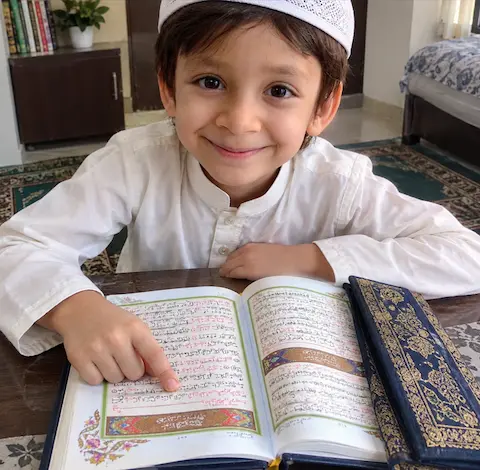
Nazra means reading the Quran aloud from the mushaf, the printed copy of the Quran, with correct letters, sounds and flow. At The Sanad Academy, a live teacher sits with you one on one over video. You read, they listen and correct you, and you keep going until you finish the whole Quran. Our students live in all fifty states, and class times fit around school, work and prayer.
Your first 30 minute class is free.
Read aloud
Correct sounds
Smooth flow

50 states
Our students live in all fifty states.
What Does Nazra Mean in Quran Learning?
Nazra is an Arabic word that means “looking at.” In Quran learning, it means reading the Quran by looking at the written text, without memorizing it. You open the mushaf, follow the lines and recite each verse in your own voice.
You don’t need to understand Arabic to do this. You learn to recognize the letters, say them the way the Quran is meant to be said, and read smoothly from the first page to the last. Many people in the USA grow up around the Quran but never learn to read it themselves. Nazra fixes that.
Nazra
“looking at”: reading the written text
How Is Nazra Different From Noorani Qaida, Tajweed and Hifz?
Each one is a separate stage with a different goal.
Stage 1
Noorani Qaida
Noorani Qaida teaches the alphabet and basic reading rules.
Stage 2 · This course
Nazra
Nazra builds fluent reading of the full Quran.
Stage 3
Tajweed
Tajweed polishes pronunciation with detailed rules.
Stage 4
Hifz
Hifz is memorizing the Quran by heart.
Think of it like learning any language. Qaida is learning your ABCs. Nazra is reading real books out loud. Tajweed is working on your accent and delivery. Hifz is learning the book by heart. Most students go in that order, though they overlap a little. Our Nazra classes already include basic Tajweed, because correct reading and correct sounds can’t be separated for long.
Who Is This Course For?
It’s for anyone who can’t yet read the Quran on their own, or who reads it slowly, with mistakes, or without confidence. The age doesn’t matter. We’ve taught seven year olds and seventy year olds.
Children
Most children are ready to start Nazra between ages 5 and 7, once they can sit still for half an hour and know their English alphabet. A child who has already finished Noorani Qaida can begin right away. A child who hasn’t can start with us from the first letter.
Short classes work well for kids. Thirty minutes is enough to learn and not so long that attention drifts. Parents are welcome to sit nearby, especially in the first few weeks. We also send a short note after each class so you know what your child worked on.
Adults
Many adults in the USA feel shy about this. Maybe you came from a family that never taught you, or you grew up in a town with no mosque school nearby. That’s very common, and our teachers treat it as normal. Nobody will make you feel behind.
Adults often learn faster than they expect. You can focus longer, you understand why you’re practicing, and you can fit in daily review. A one on one class also means no one else hears you stumble.
New Muslims and Non-Muslims
If you recently took your shahada, you can start from zero. We go slowly, explain every new sound in plain English and never rush you. People who are curious about the Quran but aren’t Muslim are also welcome to learn reading skills. Just tell us in your trial class and we’ll set a pace that suits you.
Families Who Want to Complete a Khatam
A khatam is finishing the Quran from beginning to end. Many families dream of a khatam celebration for a child or for a parent who is learning late in life. We build lesson plans around that goal, with a clear target date, and we help you plan a small celebration at home when it happens.
Slow Readers and People Who Stammer
Some students read very slowly, or stammer when they’re nervous. A live one on one class is a good fit for this. Your teacher waits for you, never finishes your sentences, and builds speed gradually. Many students find that reciting the Quran, with its steady rhythm, actually helps them feel calmer and more fluent.
Do You Need to Learn Noorani Qaida First?
No. You need to know the Arabic letters and the vowel marks before you can read the Quran, but you can learn them with us as part of your plan. If you already know them, we test your level in the trial class and place you correctly.
Here’s a quick way to check. Open a mushaf to any page.
If you can name most letters and read short words, even slowly,
You can start Nazra
If the page looks like a pattern of curves and dots,
Begin with Noorani Qaida
Our teachers will tell you honestly which one you need. Skipping Qaida when you aren’t ready only creates bad habits that take months to fix later.
What Will You Learn in Our Nazra Course?
You’ll learn to read every page of the Quran by yourself, with correct sounds and a steady pace. Along the way you’ll pick up letter shapes, the vowel marks, how words join, and the basic Tajweed rules that every reader needs.
Here’s what the course covers in detail.
01
Letters and where they’re pronounced
The Quran has 28 letters, and some sounds don’t exist in English. Your teacher shows you where each sound comes from in your mouth and throat. The names for these exit points are called makharij. You’ll practice them out loud until they feel natural.
02
Vowel marks and stops
Small marks above and below letters tell you how to say them. Fatha, kasra and damma are the short vowels. Tanween adds an “n” sound at the end of a word. Sukoon tells you to stop the sound. Once you know these, you can read any word.
03
Joining letters into words
Arabic letters change shape depending on where they sit in a word. You’ll learn this slowly, with real Quran words rather than made up examples.
04
Reading verses
Once words feel easy, you move to full verses. You learn where to pause, where to continue and how to keep your breath steady.
05
Basic Tajweed rules
Tajweed is the set of rules for reciting correctly. In Nazra you learn the ones that matter most for everyday reading, like stretching certain sounds and softening others. Deeper study comes later in a separate Tajweed course.
06
Daily recitation habits
We teach you how to practice at home between classes, even if you only have ten minutes.
07
Short duas and basic Islamic knowledge
Many students also want to learn the daily duas, such as the ones for eating, sleeping and leaving the house. We add these gently into lessons, especially for children.
How Does the Course Move From Juz Amma to a Full Khatam?
You start with the short chapters at the end of the Quran and slowly work toward the longer ones. Each stage builds on the last, so you’re never asked to read something you aren’t ready for.
1
Stage One: Short Surahs
You begin with the small chapters most Muslims already hear in prayer, like Al Fatiha, Al Ikhlas and Al Falaq. They’re short, familiar and good for building confidence.
2
Stage Two: Juz Amma
This is the 30th section of the Quran, made of short chapters. Finishing it is a real milestone. Many children cry happy tears when they complete it, and so do some adults.
3
Stage Three: Longer Surahs
Now you move to chapters like Al Baqarah, which has long verses and more complex rules. Your speed grows here, and your teacher watches closely for small mistakes that repeat.
4
Stage Four: The Full Mushaf
You read page by page from the start of the Quran. By now you can handle most words without stopping.
5
Stage Five: The Khatam
You finish the last page. Many students then keep reading with us at a quicker pace to stay sharp, or move on to Tajweed.
What Happens in a 30 Minute Nazra Class?
You spend the first few minutes reviewing your last lesson, then read new lines with your teacher, then practice the hard spots. Here’s how a typical class looks.
5 minutes
Review
You re-read the last lesson while the teacher listens. If you stumbled before, this is where you fix it.
15 minutes
New reading
The teacher shows you the next few lines. You read slowly, the teacher corrects any wrong sound, and you repeat it until it’s clean.
5 minutes
Rules
If a new Tajweed rule appears in your lines, the teacher explains it simply and gives two or three examples.
5 minutes
Practice and homework
You get a small task, like reading one page aloud three times before the next class. The teacher also writes short notes so you remember what to work on.
Since it’s one on one, the teacher’s full attention stays on you. Nobody waits for another student’s turn.
What Are the Three Speeds of Quran Recitation?
There are three common speeds: slow, medium and fast. In Arabic they’re called tahqeeq, tadweer and hadr. A good reader can move between them depending on the situation.
Tahqeeq
Slow
Slow recitation is used for learning and careful reading.
Tadweer
Medium
Medium is a calm, steady pace, common in prayer and personal reading.
Hadr
Fast
Fast is used by experienced readers, for example when finishing the Quran quickly in Ramadan.
You should always start slow. Speed comes after accuracy, never before. If someone rushes you in your first month, that’s a warning sign about the teacher.
How Long Does It Take to Learn Nazra Quran?
For a child who already knows the letters, most plans take about 6 to 12 months at three classes a week. Adults often finish in 4 to 9 months with the same schedule. A complete beginner who starts with Qaida usually needs 12 to 18 months in total.
These are typical numbers, not promises. Your speed depends on how often you attend, how much you practice at home and how old you are. Students who practice for just 15 minutes a day often finish months ahead of students who only read during class.
A good rule: two short sessions a day beat one long session a week. Your tongue and ear need repetition more than they need effort.
Three classes a week
A child who already knows the letters
6 to 12 months
Adults
4 to 9 months
A complete beginner who starts with Qaida
12 to 18 months
Which Class Plan Fits Your Family?
Most students pick between two, three or four classes a week. Here’s how they compare.
2
Two Classes a Week
This is the gentlest plan. It suits busy adults and young children with a full school schedule. Progress is steady but slower. Expect the longer end of the time ranges above.
Our usual recommendation
3
Three Classes a Week
This is the plan we recommend to most families. It’s a good balance of progress and daily life. Students remember last class’s lesson and don’t lose momentum.
4
Four Classes a Week
This is for students who want to finish fast, such as a teen preparing for Ramadan, or an adult with a clear goal. It needs more home practice, so make sure you have the time.
You can switch plans later. If a school term gets busy, drop down. If summer break opens up, speed up.
Which Mushaf Do We Use in Class?
We use the mushaf you already have at home, as long as it’s a clear, standard copy. Two kinds are very common in the USA: the Madani mushaf, with 15 lines per page, and the South Asian style mushaf, with 16 lines per page. Both are fine.
What matters is that you always use the same copy, so your eyes learn where words sit on the page. If you don’t own one yet, we’ll tell you which type to buy in your trial class. Plan on reading roughly 5 to 15 lines per class, depending on your level. Beginners read fewer lines with more care.
15 lines
Madani mushaf, per page
16 lines
South Asian style mushaf, per page
5–15 lines
Roughly how much you read per class
When Are Classes? Timing Across US Time Zones
You pick the time. We have teachers available across a wide range of hours so you can fit lessons around school and work, whichever coast you live on.
Eastern and Central Time
Families in places like Queens, Brooklyn, Jersey City, Chicago and Houston often choose after school slots between 4 PM and 7 PM, or a late slot after Isha prayer. Working adults like early morning before the commute.
Mountain and Pacific Time
In cities like Denver, Phoenix, Los Angeles and San Jose, many students book after school or on weekends. Evening classes after dinner are also popular.
Alaska and Hawaii
We can usually match you with a teacher, though your options may be a bit narrower. Tell us your time zone early so we can find a good slot.
Daylight Saving Changes
Clocks change twice a year in most of the USA. Your class stays at the same local time, and your teacher adjusts. Just remind us in March and November so nothing gets mixed up.
How Do Teachers Track Your Progress?
After each class, your teacher records what you read, what went well and what to practice. Every month, you get a simple progress report. If you’re a parent, this tells you exactly where your child is in the mushaf and what’s next.
A good report names real things. For example:
“Reads Juz Amma with two small mistakes on the letter ع. Next goal is Surah Al Mulk.”
If a report only says “doing well” every month, ask for more detail. You deserve to see it.
Can You Choose a Male or Female Teacher?
Yes. We have both, and you can choose. Many sisters and young girls feel more comfortable with a female teacher, and many parents prefer it. Some families like a male teacher for their sons. Tell us when you book your trial, and we’ll match you. If the first match doesn’t feel right, you can ask for a change. We won’t take it personally.
What Do You Need to Join Online Classes?
You need a phone, tablet or computer with a camera and a decent internet connection. A computer or tablet is better than a phone, because you can see the mushaf and the teacher clearly. You also need a quiet corner, a copy of the Quran and a pen for notes.
Phone, tablet or computer with a camera
Decent internet
A quiet corner
A copy of the Quran
A pen for notes
You don’t need any special software. We’ll send you a simple link and walk you through it in the trial class. If something goes wrong with your connection, your teacher will help you fix it, or you can rejoin on a phone.
How Much Do Online Nazra Classes Cost in the USA?
Prices vary by plan, so we share exact USD fees when you request your free trial. For a general idea, online Quran academies in the USA commonly charge anywhere from about $60 to $150 a month, depending on how many classes you take each week and how long they are.
$60–$150
a month is what online Quran academies in the USA commonly charge.
When you compare prices, check what you’re getting. Is the class truly one on one, or is it a small group? Is the teacher qualified? Do you get progress reports? Can you change teachers? A very cheap plan with rushed classes costs more in the end if you have to start over.
Is There a Free Trial?
Yes. Your first class is free. It’s a live 30 minute session with a real teacher, not a recording. You’ll read a little, get your level checked and ask any questions. There’s no payment needed to book it, and you can walk away with no hard feelings if it isn’t right for you.
Common Mistakes That Slow Students Down
A few habits hold back many learners. Knowing them early saves you months.
✕
Skipping the basics is the biggest one. Jumping into long surahs before the letters are solid leads to guessing, and guessing becomes a habit.
✕
Reading too fast is another. Speed feels like progress, but it hides errors. Slow and clean beats fast and sloppy.
✕
Many students also practice only during class. Even ten minutes a day makes a big difference. Try tying it to something you already do, like right after Fajr or right after dinner.
✕
Some learners also read from an app or a phone screen only. Screens are fine for review, but a printed mushaf helps your eyes learn page layout. Keep both if you like, but make the printed copy your main one.
✕
Finally, some students stay silent when they don’t understand. Ask. Teachers would much rather repeat a rule than watch you struggle.
Tips to Read Faster and Better
Before your next class
Read the same page aloud three times before your next class. Record yourself once a week and listen back. You’ll hear mistakes you can’t catch while reading.
While you read
Use a pencil to point at each word while you read. It keeps your eyes from jumping ahead. Listen to a good reciter for five minutes a day, and then copy the rhythm. Take short breaks if your tongue gets tired.
For kids
For kids, small rewards work well. A sticker chart for each page finished can turn practice into a game.
What Comes After Nazra?
Once you can read the whole Quran fluently, you have a few good next steps.
Next step
Tajweed
A full Tajweed course goes deep into the rules of recitation, so your reading sounds polished and accurate. Many students find this the most rewarding next step.
Next step
Hifz
If you or your child wants to memorize the Quran, your Nazra skills are the foundation. Reading with confidence makes memorizing far easier.
Next step
Quran Translation and Meaning
Reading is the first step. Understanding what you’re reading is the next. Many students start translation classes after Nazra so they can feel the meaning of the verses they recite.
Yes
Can You Read the Quran Without Knowing What It Means?
Yes, and reading it still carries great reward. Many Muslims around the world, including native Arabic speakers, read the Quran in this way first and study meaning later. We encourage you to add translation study when you’re ready, because understanding makes recitation more moving.
Clear, correct, confident
Will You Have a Beautiful Voice After This Course?
You’ll have a clear, correct and confident voice. A beautiful melodic voice takes more time and more practice, and it’s a skill some people develop and others don’t focus on. Nazra gives you the base. If you want to go further, your teacher can suggest listening practice or recommend a recitation style course later.
Frequently Asked Questions
What age can my child start Nazra Quran online?
Most children start between ages 5 and 7. The child should know the English alphabet and be able to focus for 20 to 30 minutes. Younger children can begin with Noorani Qaida and move to Nazra when they’re ready.
Can adults learn Nazra Quran online?
Yes. Adults are some of our most dedicated students. Classes are one on one, so there’s no pressure and no comparing yourself to others. Many adults complete the whole Quran in under a year.
Do I need to know Arabic before I start?
No. You only need to learn the letters and vowel marks, and we teach those. You don’t need to speak or understand Arabic to read the Quran aloud.
How long are the classes?
Each class is 30 minutes, live over video. You can book two, three or four classes a week depending on your goals and schedule.
Is the free trial really free?
Yes. The trial class costs nothing and needs no payment details. You meet a teacher, read together, get your level checked and decide if you want to continue.
Can I pick a male or female teacher?
Yes. Tell us your preference when you book and we’ll match you. If it doesn’t feel right, we’ll switch you.
Do you teach students outside of big cities?
Yes. All you need is internet. Whether you live in a large city like Dallas or a small town in Ohio, your class feels the same, because it happens on a screen.
Your first lesson is free
Book Your Free Trial Class
Reading the Quran yourself is closer than you think. Book your free 30 minute trial with The Sanad Academy, meet your teacher and find out exactly where to begin. Send us a message today with your time zone and the best hours for you, and we’ll set up your first class.